Also on this site:
blob Landscapes
blob People, places, things
blob Cycle touring
blob Walks
blob Info, contacts, ...
blob tango
© David Houlder
-> Info, contacts, ... -> Recipes Photography by David Houlder
 

Recipes

Only two recipes at the moment.
  • Bagels - the best home-made bread thing I've ever eaten.
  • Mattar Pannir - an excellent cycle-touring/bushwalking meal

David's bagel recipe

Ingredients
  • 6 cups of high gluten or "bread making" flour. I've had good results with stuff thats labeled "continental flour" ("Solomon's" and "Tasty" brands), and also with "Pasta Dura" flour ("No Knead" brand). Don't use bog-standard cake making flour - you'll probably get squishy, unconvincing cake-like bagels.
  • 2 cups of warm water. Probably around 40°C. Not so hot that you can't keep your fingers in it indefinitely.
  • 2 sachets of yeast (7g each) Ordinary supermarket yeast seems OK.
  • 1/3 cup of sugar for the dough
  • About 2 tablespoons of sugar for the boiling process.
  • 1 tablespoon of salt
  • A few teaspoons of poppy seeds, sesame seeds or whatever for sprinkling on top.
  • 1 egg white
  • Butter for greasing baking trays
  • oil for greasing the bowl
Utensils
  • Oven and stove
  • Cup measures
  • Big pot for boiling the bagels in. Anything about 30cm in diameter or bigger
  • Bowl to mix the dough in, preferably ceramic. Should be big enough to hold, say, 16 cups.
  • Clean surface to knead on
  • Warm place or a sink full or warm water where the dough can rise.
  • Tongs or egg-flip or something to manipulate and retrieve the boiling bagels
  • Baking trays or sheets. Apparently you can get insulated ones, which would probably be good, although I manage without.
  • Pastry brush
  • Plastic bags or cling wrap to cover bagels with at various points.
  • Timer or clock
  • Cooling racks
Method
  1. Put the 6 cups of flour into the mixing bowl
  2. Add 1/3 cup sugar, 1 tablespoon salt
  3. mix well
  4. add the 2 sachets of yeast
  5. mix well
  6. Slowly add most of 2 cups of warm water to the bowl while stirring. Once the flour mix becomes wet you can't really stir it - you sort of have to poke it and tumble it around, but the general idea is to get the water evenly distributed through it.
  7. At this stage the dough will probably still be looking a bit dry. If so, add the remainder of the 2 cups of water and mix in.
  8. Pour out the dough onto your clean surface.
  9. Knead it for 10 minutes. Knead it until you think your arms are going to drop off, then knead it some more. Too much kneading is barely enough. 10 minutes of kneading is a very long time, and if you aren't wearing just a t-shirt by the end of it you haven't really been trying.
  10. Grease the bowl with the oil
  11. Put the dough back in the bowl and cover it with a plastic bag or cling wrap
  12. Put the bowl in a warm place. I usually float it in a sink full of warm water - about 30°C, maybe a little warmer. If the bowl is ceramic it will sink enough to be fairly evenly warmed by the water.
  13. Pre-heat oven to about 250°C. You actually cook the bagels at about 180°C, but it helps to start a bit hotter. Make sure the oven racks are set so that you can get your baking sheets and bagels in comfortably. It helps if you can arrange the racks so that the bottom-most one doesn't get blasted by the bottom element in an electric oven, so shield it with a dummy baking tray or something if possible. Also avoid getting too close to the top of the oven as that also seems to be a hot spot.
  14. Wait one hour for the dough to rise.
  15. Check the dough. Should be about double the volume you started with. If not leave it a bit longer.
  16. Fill the big pot with water to a depth of at least 10cm
  17. add 2 tablespoons sugar to the big pot
  18. cover the pot
  19. Put it on high heat on the stove
  20. Pour the dough out of of the bowl onto a cutting board or something
  21. Cut the dough into 12 evenly sized pieces, and form each one into a ball. Set each ball aside and cover with plastic bags or cling wrap.
  22. Form each ball into a bagel or doughnut shape. My approach is to poke it from both sides with my index fingers. When my fingers meet, I roll them around to expand the dough into its bagel shape. Set aside each formed bagel under the plastic bag.
  23. Grease your oven trays or baking sheets.
  24. Wait 10 minutes or until the big pot is boiling, whichever is longer.
  25. Boil each bagel for 3 minutes, turning every 30 seconds. I usually do about 3 at once. Use tongs or an egg-flip to turn them over in the water.
  26. Set aside each boiled bagel to drip dry a bit before putting on the baking sheets,
  27. Brush the bagels with the egg white
  28. Sprinkle on the poppy seeds, sesame seeds or whatever.
  29. Set the oven back to a "genuine" 180°C. Every electric oven I've ever used seems to be a bit slow, and so I generally set the dial to about 200°C. If you have a new or fan-forced oven, set it to 180°C.
  30. Put the bagels in the oven.
  31. After about 20 minutes, quickly open the oven and check the progress. If some are starting to brown, rotate them to a cooler part of the oven. Depending on the oven and the baking sheets, you might find they brown first on the top or the bottom.
  32. After a further 10 minutes (i.e. 30 minutes total cooking time), some or all of the bagels should be done. They should be a light tan colour, and hopefully not too brown on the bottom.
  33. Set bagels aside to cool
  34. Eat!

Mattar Pannir

This is a great meal for walks or cycle trips. The feta is perishable, so it's a good first- or second-day meal, but everything else would probably last for months. The idea is that you pound all the dry spices together before you go and then turning it into dinner is a no-brainer. If you're going on a cycle trip, pack enough of the non-perishable ingredients for several meals, and then just buy the cheese as you need it.

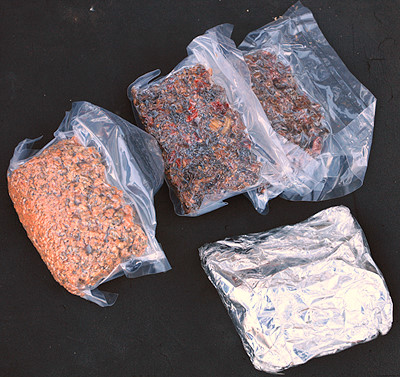
I've also successfully used a dehydrated version of this dish. I cooked up the whole dish (without the rice), then spooned globs of it onto the racks of a domestic food dehydrator (basically a redesigned hair dryer), and scraped the dried mixture off the racks about 24 hours later. I'm not entirely sure about the keeping properties of dried feta, but it tasted pretty good when I rehydrated it 2 weeks later.

Ingredients (Probably makes 2 serves. YMMV)
  • 50g ghee
  • 4cm ginger root
  • 2 garlic cloves
  • 1.5 teaspoon coriander seeds
  • 0.5 teaspoon cardamom seeds
  • 0.5 teaspoon hot chilli powder
  • 1 teaspoon tumeric
  • Probably 50g to 100g Freeze-dried green peas.
  • 350g feta cheese
  • 3 tomatoes (optional)
  • 1 tablespoon coriander leaves
  • Serve with rice (Basmati is good - tastes good, takes 10 mins to cook)
Method (10 - 30 mins depending on stove)
  1. Pound the coriander seeds, cardamom, chilli and tumeric together in a mortar and pestle.
  2. Finely chop the garlic and ginger
  3. Melt the ghee in a pot big enough to hold all the ingredients (Trangia works fine).
  4. Add the spices, ginger and garlic.
  5. Fry gently for, say, 5 mins. Don't overdo it. You don't want the garlic to caramelise.
  6. Add the freeze-dried peas and enough water to reconstitute them.
  7. Bring to boil and simmer
  8. When the peas are about half-reconstituted (still a little crunchy), add the cheese. Break it up so that it melts quicker.
  9. Simmer gently and stir until all the cheese has melted and the peas have completely reconstituted.
  10. Set the dish aside and cook the rice in another pot. It will stay hot for quite a while.
  11. Add the tomatoes and coriander leaves if you have them.
  12. Eat
  13. Wash up - yeah, OK, it's a bit of a hassle to wash up with all that melted feta everywhere, but it's worth it.